
Dorie Miller: African-American Hero of Pearl Harbor
On December 7, 1941, as Japanese bombs tore through the U.S. Pacific Fleet at Pearl Harbor, Doris “Dorie” Miller, a Black mess attendant aboard the USS West Virginia, answered a call to heroism. Though restricted by U.S. Navy segregation policies, Miller carried wounded shipmates to safety and manned an anti-aircraft gun with no formal training. His actions that day not only made him one of Pearl Harbor’s bravest figures but also positioned him as a symbol of courage, resilience, and the ongoing fight for African-American equality in the U.S. military.
Week 3: World War II & The Fight for Military Integration
From Waco to the West Virginia

Born in 1919 in Waco, Texas, Doris “Dorie” Miller grew up the son of sharecroppers, working hard from an early age. Seeking opportunity, he enlisted in the U.S. Navy in 1939, hoping for adventure. Yet like every Black sailor of the time, the adventure offered was strictly limited.
Miller was assigned as a Mess Attendant Third Class aboard the USS West Virginia. His duties? Cooking, serving, cleaning — no combat training, no leadership path. In the eyes of the Navy, Dorie Miller was not a fighter. But history had other plans.
December 7, 1941: Courage Without Orders
When the Japanese launched their surprise attack on Pearl Harbor, chaos engulfed the Pacific Fleet. Miller sprang into action without hesitation — pulling wounded shipmates from smoke-filled compartments, carrying them to safety, including the dying captain of the West Virginia, Mervyn Bennion.
Then came the defining moment. Spotting an unmanned .50 caliber anti-aircraft gun, Miller, without formal gunnery training, took control.
In his words:
“It wasn’t hard. I just pulled the trigger and she worked fine.”
Witnesses say he fired until he ran out of ammunition, possibly downing one or more enemy planes. His calm, instinctive bravery under fire marked a seismic moment — not just for Pearl Harbor but for African-American service members watching.
A Hero in the Headlines, but Not in the Ranks
News of Miller’s actions, initially buried in vague Navy reports, spread through the Black press. The Pittsburgh Courierand other Black newspapers led a determined campaign demanding that the man behind the gun be named and honored.
Eventually, the Navy relented. In May 1942, Admiral Chester W. Nimitz personally awarded Dorie Miller the Navy Cross, the second-highest award for valor in combat. Nimitz’s words were historic:
“This marks the first time in this conflict that such high tribute has been made in the Pacific Fleet to a member of his race.”
But while he was celebrated in headlines, Miller’s rank and role in the Navy did not change. He remained a mess attendant. America was willing to praise a Black hero — but not yet promote him.
Returning to Duty — And Making the Ultimate Sacrifice
Miller continued to serve faithfully. Assigned to the escort carrier USS Liscome Bay, he became known for his quiet dignity among his shipmates.
Tragically, on November 24, 1943, the Liscome Bay was torpedoed near the Gilbert Islands. Dorie Miller was among the 646 men lost. He was only 24 years old.
His mother said simply:
“Dorie died the way he lived — helping others.”
The Legacy That Would Not Be Buried
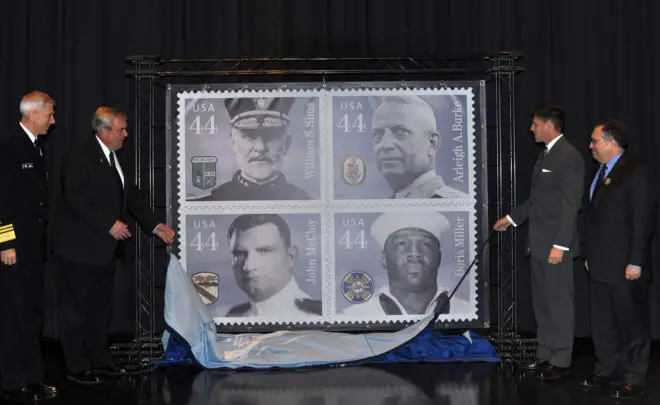
Though his life was short, Miller’s legacy lived on. His story became a catalyst for the eventual desegregation of the U.S. Armed Forces in 1948. His bravery was included in war bond drives, recruitment posters, and films.
Over the years, schools, streets, parks, and community centers were named in his honor. In 2020, the U.S. Navy announced the construction of the USS Doris Miller (CVN-81) — the first aircraft carrier named for an African-American and for an enlisted sailor. The announcement was itself a historic corrective to decades of omission.
Today, Dorie Miller stands as an enduring symbol of courage, duty, and the unrecognized contributions of countless African-Americans in uniform. He didn’t just fight for his country; he fought for his people.
“Above all, Dorie Miller represents the best in all of us,” said Admiral Michael Gilday, Chief of Naval Operations, at the ship’s naming ceremony.
WATCH: How Texas Son of Sharecroppers Became WW2 Hero (Pearl Harbor)