
“Elizabeth Catlett: A Black Revolutionary Artist and All That It Implies”
The Brooklyn Museum is showing a wonderful retrospective “Elizabeth Catlett: A Black Revolutionary Artist and All That It Implies” by the late African-American/Mexican artist Elizabeth Catlett. This exhibit may be one of the more thoughtful and stirring exhibitions of the fall season. Various prints, drawings, and sculptures (wood and terra cotta) from throughout her long career are displayed here, and no doubt a few will haunt you, prod you, and move you.
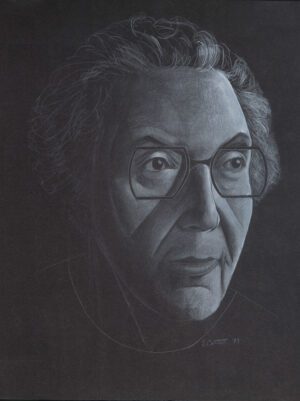
Exhibition Title and Themes
“Elizabeth Catlett: A Black Revolutionary Artist and All That It Implies” might seem a provocative title, although if the curators had just called it “Elizabeth Catlett: A Retrospective,” it might not garner enough attention. But after careful viewing of the exhibition, I am tempted to call it “Elizabeth Catlett: Immense Career, Intimate Works.” Many of the artworks on display have underlying themes of identity, struggle, and inequity, yet they also show great humanity, especially evidenced in the faces and their expressions. Several pieces reveal people, especially women, at their most vulnerable moments. And we at ROUTES have followed her career in the past, too.
Elizabeth Catlett’s Background
Catlett filled her 96 years with a great deal of achievement. Her family came from modest means, and her grandparents were freed American slaves. She earned a BA and an MFA, being the first African-American woman to earn that degree at the University of Iowa. She taught high school, adult education, university-level courses, and studied further arts in a few different schools. She entered the renowned Mexican workshop Taller de Grafica Popular. She produced hundreds of works, including those dedicated to promoting activism, as well as public works seen at schools and in urban settings. She lived in several American cities and a few places in Mexico and was active as an artist till the very end of her life. Her works are found in several collections around the United States and in Mexico.
Themes and Artistic Impact
Stroll around this exhibition and examine carefully the faces of the majority of the works displayed. So many of Catlett’s prints, drawings, and sculptures depict faces with emotion and gravitas. Look at the ways in which Catlett rendered eyes, mouths, cheeks, and chins. The faces pull you in, and sometimes it is hard to look away. If you are an artist or writer, her works will likely influence you in some manner.
Bilingual Presentation
Catlett spent a significant part of her life in Mexico, and the Brooklyn Museum has provided all the text in both English and Spanish. This is a wise move on the part of the Museum and should appeal to many visitors, especially those who may not typically flock to the Brooklyn Museum; I hope they do outreach to the Latino community and promote this. (It will also be a wise move for them to do outreach to Spanish language teachers throughout NYC).
“Elizabeth Catlett: A Black Revolutionary Artist and All That It Implies” Arrangement
It is an intriguing and fitting move on the part of the Museum to wrap part of the Catlett exhibition around the permanent exhibition “The Dinner Party” by Judy Chicago. This well-known, triangular display is a key piece in American feminist art. Elizabeth Catlett’s many pieces that feature women are extremely fitting, by being adjacent to the Judy Chicago work.
Notable Pieces
Among my favorite pieces were:
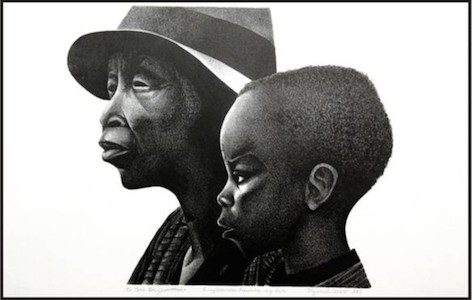
- Torture of Mothers (lithograph, 1970) — A picture of a mother, her child tortured, occupying her head, her mind, her every thought. The woman has a restrained look, perhaps defeated, with pained thoughts about her child, who lies crumpled, defeated. Is the child hurt or dead? Or is it her fear that this could happen sometime in the near future or later?
- Young Girl (sculpture, 1946) A bust with finely chiseled facial features. We look at this artwork and try to interpret her thoughts, her demeanor, her emotions. Is she lost in wonder or confusion? Is she watching or being watched? We can project onto this lovely sculpture.
- Tired (sculpture, 1946) —A well-known work at Howard University. This sculpture of a seated woman, her shoulders bowed, and a weary expression on her face, is an Every Woman. A detail to be noticed is her right hand cupped, with fingers pointing upward. It could be a hopeful sign, a bit of subtle optimism, for a woman who appears bone-tired.
- Four Singers (print) — A print of the four singers (two female, two male) in the Howard University choir, very sweet and quite different, including the emblem of the school and musical notes. The mood of this artwork is very different from nearly everything else in the exhibition; it has a cheerful spirit, depicts teamwork, and all four vocalists echo each other with the shapes of their mouths, their eyes focused on the emotion of singing.
- Black Unity (sculpture, 1968) — The raised fist sculpture from 1968, carved from wood, is bound to be a crowd-pleaser; even during the press event, I saw visitors snapping photos of themselves, posing with this piece. This proud and strong salute, rendered in cedar, will bring to mind many events of the 1960s. It is more than a symbol, though, in this large and solid rendering.
Exhibition Artifacts
The exhibition is more than just a collection of her works: you can also see an assortment of her tools, as well as her eyeglasses. There are announcements of some of her shows, correspondence, as well as photographs of her with artists and writers. (There is a sweet snapshot of her with Faith Ringgold.)
Reflection on the Title “Elizabeth Catlett: A Black Revolutionary Artist and All That It Implies”
I read carefully the title of the exhibition before I saw it, as well as after, and at first found it a bit ponderous. But upon further reflection, she was revolutionary in many ways. In her photographs, she seems rather like many women you and I know. She didn’t seem like an outrageous media figure, but rather like someone’s mom and later someone’s grandmother. But when she delivered her finished artworks, they certainly had a power to them that couldn’t be overlooked.
Relevance Today
We are now living in times in which the rights of women, people of color, immigrants, and the poor and working class are threatened by politicians and pundits, hate groups, and media influencers with outsized power. Elizabeth Catlett’s artworks are quite relevant in today’s climate, and many of them have a timeless quality. View these works, and decide for yourself how revolutionary they were and still are.