
Sgt. Henry Johnson: The One-Man Army of WWI
Sgt. Henry Johnson wasn’t just a soldier. He was a man who stood when everything around him said fall back. He fought not only for his country, but through its hypocrisy. His legacy now lives in classrooms, museums, memorials—and in the renewed efforts to give long-overdue recognition to Black veterans.
His story is not only about bravery in battle — it is about justice delayed, but not denied.
Week 2: World War I & The Struggle for Recognition
The Man Before the Medal
Born in Winston-Salem, North Carolina in 1892, William Henry Johnson moved to Albany, New York as a young man. Before enlisting, he worked as a laborer and train station porter. In 1917, he joined the all-Black 15th New York National Guard Regiment, which would soon be redesignated as the 369th Infantry—the famed Harlem Hellfighters.
Despite enlisting to serve his country, Johnson, like all Black soldiers, faced harsh discrimination. African-American troops were often assigned menial labor tasks, denied combat training, and mocked by white officers. It wasn’t until the 369th was assigned to the French Army that Johnson saw the front lines.
The Night That Made History
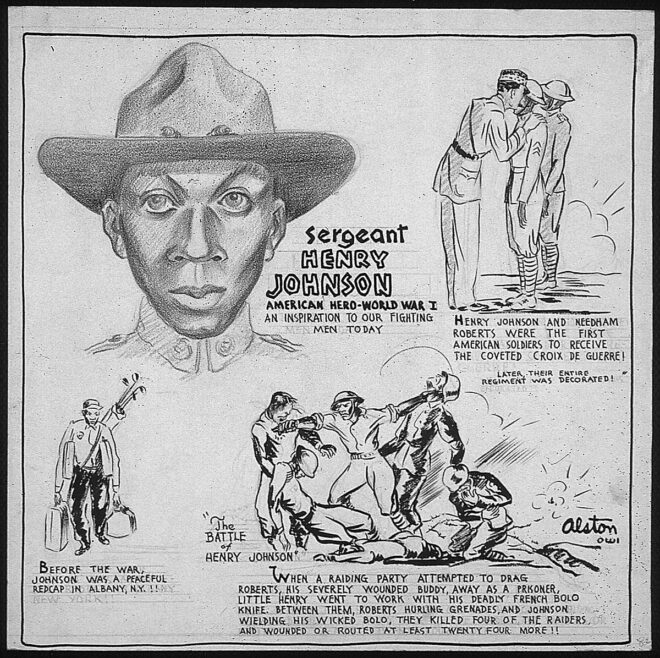
On the night of May 14, 1918, Johnson and fellow soldier Needham Roberts were on sentry duty in the Argonne Forest when a German raiding party—nearly two dozen strong—launched a surprise attack.
Roberts was badly wounded in the first volley. Johnson, injured himself, refused to abandon his comrade. When his rifle jammed after firing all its rounds, he lobbed grenades until they were gone. Then he used the butt of his weapon to beat back attackers. When that broke, he drew his bolo knife — a short, curved blade — and charged into close combat.
He fought with such intensity that the Germans fled, dragging their wounded and dead. Johnson not only saved Roberts but prevented the Germans from breaking the line. His actions were described as “extraordinary valor.”
France Honors Him—America Turns Away
The French awarded Johnson the Croix de Guerre avec Palme, the nation’s highest military award, making him the first American to receive it. But the U.S. military offered no recognition. Johnson was never awarded a Purple Heart during his lifetime. He received no disability compensation, despite the serious wounds he sustained.
He returned to New York in 1919 and was celebrated by Black communities and the press. He even took part in a parade down Fifth Avenue. But without support or medical care, Johnson’s health declined. He eventually died in 1929 at the age of 32, poor, in pain, and largely forgotten.
A Delayed Reckoning
For decades, Johnson’s heroism remained buried under layers of bureaucracy and neglect. But activists, historians, and military advocates worked to restore his honor. Slowly, the tide turned.
In 1996, President Bill Clinton posthumously awarded him the Purple Heart. In 2002, he received the Distinguished Service Cross. And finally, in 2015, President Barack Obama presented Johnson’s family with the Medal of Honor, calling him “a soldier who should have been celebrated in his lifetime.”
Today, Johnson is buried at Arlington National Cemetery, and a statue stands in his honor in Albany, New York.
A Symbol of Courage — and a Call to Remember
Sgt. Henry Johnson wasn’t just a soldier. He was a man who stood when everything around him said fall back. He fought not only for his country, but through its hypocrisy. His legacy now lives in classrooms, museums, memorials — and in the renewed efforts to give long-overdue recognition to Black veterans.
His story is not only about bravery in battle — it is about justice delayed, but not denied.
WATCH: Pentagon Hall of Heroes: Sgt. William Shemin and Pvt. Henry Johnson
WATCH: Black Death: The Harlem Hellfighter Soldier Who Fought Off 20+ Germans At Once