
Honoring Black Legacy: Park Avenue Armory and The Met’s Cultural Showcases

Two of New York City’s premier institutions, Park Avenue Armory and The Metropolitan Museum of Art are honoring the Black legacy through a series of current and upcoming cultural projects.
At their annual gala held on December 3, the Armory’s curator of public programming, Tavia Nyong’o shared his excitement for the organization’s upcoming season which features a collaboration with the National Black Theatre (NBT) and a tribute to caftans inspired by fashion icon, André Leon Talley and his signature garment of choice. The latter will feature a day of talks and presentations analyzing the personal, political, and cultural significance of fashion as a tool for liberation.
“We didn’t know that The Met was gonna say this was gonna be the year of the Black dandy but we approve,” said Nyong’o in reference to The Met’s forthcoming exhibition, Superfine: Tailoring Black Style. “So it’s gonna be about caftans and looking at honoring the legacy of André Leon Talley and looking at Bethann Hardison, and so many other names who were tailblazers in fashion for people of color, for women, [and] for artistry in fashion and self-expression.”
Prior to that event the Armory will present a convening on the state of Black theater. NBT’s executive artistic director, Jonathan McCrory hopes that the program will encourage greater unity amongst Black theater practitioners. Such an outcome is sorely needed in order to help combat the disproportionately low number of Black people hired within the New York theatre industry. According to the Asian American Performers Action Coalition report for the 2018-2019 season, Black designers made up only 8.4% of those hired and only 2.6% of Broadway producers were Black.
“We want to look at the ecosystem and eco-mapping,” said McCrory. “We don’t really have an opportunity to know who are the set designers [and] who are the technicians. If you don’t know your brothers and sisters how can you have a conversation about thriving, sustainability, and building together?”

During the gala, Black dance was also highlighted with the world premiere of choreographer Kyle Abraham’s latest Armory commission, Dear Lord, Make Me Beautiful. The deeply personal work finds Abraham wrestling with issues of aging, social justice, and the emotional vulnerabilities of being human. The sweeping production marks the first time in nine years since Abraham has performed in an ensemble work he made. “During the creation process, I thought deeply about how I could express the delicate nature of aging and how we live a full life with all of its joys and sorrows, and I knew because of my personal connections to the work, I had to join my fellow collaborators in performing the work on stage,” Abraham said in a statement.
Meanwhile, on stage at The Met’s Grace Rainey Rogers Auditorium on December 7, luminaries from the worlds of art, entertainment, and academia gathered for an engaging and informative creative convening inspired by the Museum’s current exhibition, Flight into Egypt: Black Artists and Ancient Egypt, 1876-Now. With an expertly curated selection of artwork and select archival materials, the exhibition explores how Black artists have referenced Egypt as a source of inspiration, a conduit to discover and assert one’s self-identity, address issues of social justice, reconnect to ancestral ties, and imagine a brighter Afrofuture.
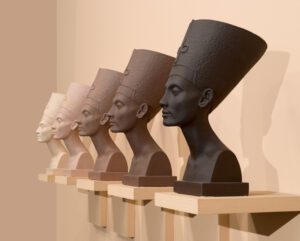
During the convening the exhibition’s curator, Akili Tommasino shared his hopes that the exhibition will center Egypt within the African historical narrative while also encouraging a deeper exploration into other ancient African cultures outside of Egypt. “I think that an intentional or unintentional side effect of the exhibition is that people will think more broadly about Africa,” he said. “But the main purpose of this project vis-à-vis Africa is to assert that 150 years of cultural production testifies to the fact that Black peoples know that Egypt is in Africa. So this is just to restore that lost or severed piece or severed part to the whole.”
Part of changing the narrative is to increase the number of Black scholars studying Egyptology and other ancient African cultures. According to a 2018 article by the Association of Black Anthropologists the number of African-American archaeologists is less than 1% of American archaeologists. Such a lack of diverse representation exacerbates the Eurocentric interpretation of ancient African studies. In the exhibition’s section titled “Egyptology and the Color Line,” Tommasino addresses the systemic exclusion of Black scholars from the field. But with this show and organizations such as Society of Black Archaeologists, he believes change will slowly take shape.
“There are increasing numbers of people of color entering fields of study that relate to ancient Africa whether that be Egyptology specifically or anthropology and archaeology,” he said. “So a growing cohort will change the way that institutional discourse deals with that part of the world.”

Other highlights from the convening included remarks from exhibiting artist, Solange Knowles; a performance from Egyptian Lover that got the crowd on their feet; and a panel discussion with exhibiting artist Renee Cox where she frequently elicited applause from the crowd with lines such as, “My thing [art] is about celebrating Black, period.”
With the Armory and The Met’s current and upcoming programs, Cox isn’t alone in wanting to celebrate Blackness. Period.
The column, On the “A” w/Souleo, covers the arts, culture, entertainment, party, and philanthropy scene in Harlem and beyond and is written by Souleo.