
“DARK NOON”
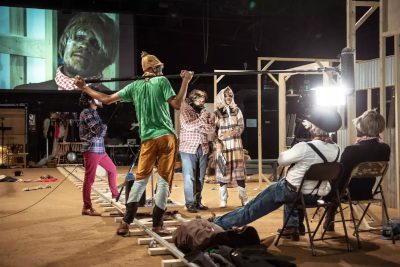
DARK NOON is a play staged by Danish Director Tue Biering and choreographed by South Africa’s Nhlanhla Mahlangu. Together, they reimagine the birth of the United States — from the arrival of Christopher Columbus to taming the wild west. The ensemble is a collection of energetic, innovative, explosive talent that titillates disbelief. They make their audiences laugh and provoke serious reflection, as well. The Guardian describes DARK NOON as, “An extraordinary outsider vision of American history.””
The ensemble is composed of seven South African performers. Six are black – Mandla Gaduka, Katlego Kaygee Letsholonyana, Bongani Bennedict Masango, Siyambonga Alfred Mdubeki, Thulani Zwane, Lillian Tshabalala-Malulyck, the only woman, and Joe Young the only white. Throughout the 90-minute performance, each cast member plays a variety of characters. They begin as the settlers and don blond wigs and powdered white faces, except Joe Young who enters as a cow that is eventually wrangled and roped rodeo-style.
DARK NOON — time periods, historical people and Howard Zinn
There are a variety of costumes and props to distinguish the time periods and historical people. Native Americans wear feathers and cowboys where ten-gallon hats. There are cassocked priests and metal straining pans to signify the gold rush. Pistols, rifles, shotguns, holsters, and whips and knives are always present no matter the era.
DARK NOON is performed in a Stadium like seating arrangement that surrounds three-quarters of an expansive space resembling an empty arena. A huge screen rises above a staging area at the far end where live closeups of the performers and audience members are projected from one of three video cameras that’s always rolling. Chapter titles and subtitles are also displayed to announce what historical situation is about to unwind. For some scenes, audience members are beckoned to participate on stage. The stories are told in rapid-fire vignettes, like the gunshots amply employed throughout the show. The scenes, whether comedic or brutal, always pierce the marrow of imagination, memory and our gross miseducation.
As a matter of fact, DARK NOON seems to lift much of its information from Howard Zinn’s “People’s History of the United States.” A thoroughly documented, unapologetic rendering of American history rife with arrogance, ignorance, murders, cannibalism, rampant greed, and senseless slaughters by the founding fathers. Just imagine how different our lives would be if we did not need to unlearn so much of what we have been taught.
DARK NOON is whimsical — that’s before the bomb drops
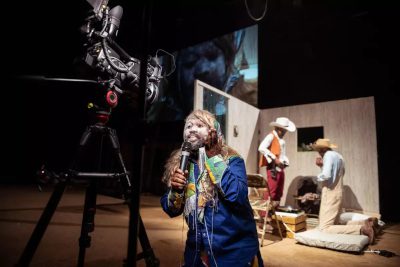
Many of the DARK NOON stories have whimsical twists in order to make the acceptance of information more palatable — that’s before the bomb drops. Take for instance, the battle between the Native Americans and the pilgrims over land ownership, A narrator explains that Native Americans have no concept of “owning land.” They believe the land belongs to everyone as does everything that sustains human life like water, animals, and plants. But the settlers want to “stake their claim” and therefore start a fight.
In no time, four of the men quickly don football helmets and padding. The woman becomes a pom-pom shaking cheerleader. A sixth actor sits in the audience portraying a sports announcer. He has a microphone and gives a play-by-play account. Meanwhile, the seventh actor walks around with a video camera taping closeups of everything in sight, including the audience.
Native American scoreboard — 3 touchdowns and counting
The first touchdown is by a Native American — everyone cheers. The second touchdown is a Native American score as well, and we all cheer. The third touchdown is also scored by a Native American and our enthusiastic cheers fill the air. But then, one of the settlers pulls out a gun and shoots the Native American.
Projected, onto the screen, are the opened mouths of a stunned audience. A second Native American runs toward the attacker and he is shot dead. The first victim slowly begins to rise only to be shot again. He rises again and is shot over and over until he is lifeless. There is a pregnant pause, then faces projected on the huge screen express shock, sorrow, anger and remorse. Moments after, the announcer unenthusiastically declares “Looks like Christopher Columbus wins.”
White audience members are auctioned off as slaves
Within the chapters, differing phases of this developing new country are revealed. White audience members are auctioned off as slaves. There’s graphic description of the decimation of buffalo herds — reduced from millions to thousands in less than 10 years. The Gold Rush era depicts hopeful miners being slaughtered by competitors. During each iteration, wooden frames are erected that represent saloons, stores, a church, a jail, restaurants, and homes. We watch immigrant Chinamen lay railroad tracks down the center of the stage. By the end of the play, the empty stage has been transformed into a bustling town complete with a working railway running through the center.
Cast Takeaways in Talkback
The final scene in DARK NOON is a dark stage with a lit elevated screen. Each actor appears, one by one, takes a seat and introduces him/herself. They each describe how American cinema informed and influenced them as an impressionable child in South Africa. Particularly, how gun violence and was romanticized, sensationalized, and glamorized. As children, they could hardly wait, after a show, to run outside and re-enact the battle and death scenes. Now, as adults, they are paid to do it.
DARK NOON has future performances booked in the United Kingdom and Finland. Right now it is at St. Ann’s Warehouse Theatre in Brooklyn (45 Water Street) through July 7, 2024.
‘Dark Noon’ review — American history dramatized with a twist