
The Swans of Harlem — Treasure It!
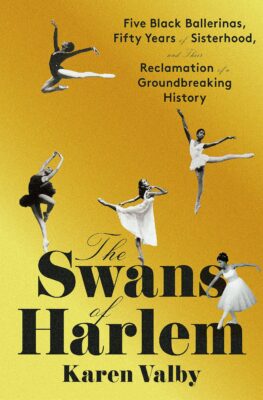
The Swans of Harlem has a few basic starting points: the most obvious is the great deal of media awareness surrounding Misty Copeland who many considered to be the first major Black ballerina…until it was discovered that she was not the first. The impetus for this book was also a New York Times article by Karen Valby, from June 2021, about five early ballerinas from Dance Theatre of Harlem.
And then there are the basic points of view: that of the ballerinas, together and as individuals; and the ballerinas and their interactions with Arthur Mitchell, the visionary dancer and founder of Dance Theatre of Harlem. In this book we read the stories, joys and sorrows, of an intriguing group of women: Lydia Abarca, Gayle McKinney-Griffith, Sheila Rohan, Marcia Sells and Karlya Shelton. Their lives, from childhood through their senior years, unfold for us and illustrate a great deal about the worlds of ballet, of Black people involved in the arts, of Black women and their professional-personal struggles, and cultural history (especially in New York City).
Some history books cover topics that are very familiar; the most obvious is the great deal of media awareness surrounding Misty Copeland, others delve into lesser-known subjects and show why they should be much better known. I would include the wonderful The Swans of Harlem in the latter category. While there are many books about dance history, about African-American history, about cultural history, and about women in history, there are very few about pioneering African-American ballerinas and their roles in promoting cultural and artistic excellence.
Let me step back for a moment and state that I adored this book; I did not want to finish reading it. And I thought about how much my mother, a devoted fan of American ballet, would have enjoyed reading this book. Karen Valby has taken a fascinating set of stories and made them come to life in ways that are greatly informative, dearly touching, and socially significant. This book flows, it engages, it is a fine example of narrative nonfiction.
We were there too
“We were there too.” These four words, repeated at various junctures in the book, carry the weight and the pride of these dancers.

They want to be acknowledged for their achievements and also for their part in inspiring other dancers of color. And a great part of their lives has been the legendary Dance Theatre of Harlem and the late Arthur Mitchell. This dance company in many ways was like a family for them, and for better and for worse, Mitchell was a father figure who was revered and feared, beloved and hated, and above all a tireless promoter and educator in the cause of serious classical dance as performed by Black dancers.
Reading The Swans, it becomes quite clear how important these dancers were, as well as the people they partnered with, the children who were students here, the dancers’ extended families, and the people of Harlem as well. They all cheered each other on; they were inspired by each other and the dance company was a true source of pride for the greater neighborhood.
Sorrows and Joys of The Swans of Harlem
Certain sections of the book were truly heartbreaking, particularly the chapters about how the AIDS epidemic stormed the male dancers and the community; the section about Arthur Mitchell’s final days and death; and segments that explained the economic hardships faced by DTH at various times, especially from the 1980s onward. Mitchell was an indefatigable man, immensely talented and driven but also prone to cruel and frustratingly high standards. We learn how much each dancer struggled with dealing with him, the pros and cons.
For the true ballet history fans, we read in depth about certain dances and their staging. As a fan of Agon, Serenade and Swan Lake, I was thrilled to read the details of these dancers working on these classics. I also learned about other dances such as Dougla and Forces of Rhythm. I went to YouTube to see evidence of these gems as well as other dances.
“The Swans of Harlem” Spotlights on Lydia Abarca
Although each lady had a fascinating biography here, Lydia Abarca’s story was particularly eye-opening and a true draw. This woman, who also modeled and graced magazine covers, still managed to be under the radar for much of the world. The Swans hopefully places Abarca in the pantheon of significant dancers.
Valby provides extensive interview segments at times, and they are wonderful, alongside the narrative that shows her extensive research into this world. This back-and-forth worked quite well throughout the book.
Arthur Mitchell, A Visionary

We also learn quite a bit about Arthur Mitchell, the seemingly tireless founder of Dance Theatre of Harlem. Mitchell was the first Black ballet star for George Ballanchine’s New York City Ballet, and was inspired by the assassination of Dr. Martin Luther King Jr. to establish and shepherd a Harlem-based, all-PoC ballet company and school. He wanted it to be on the level of serious companies throughout the world.
He was at times greatly encouraging, at others caustic; The Swans describes about how they viewed him as a father-figure who could make or break a dancer’s spirit and also maintained top-notch criteria. Abarca had a particularly close (at times) relationship with the man.
The Legacy of Arthur Mitchell: Dance Theatre of Harlem in Washington, D.C.
* * * * * * *
By the way, this is one nonfiction book that had not enough photographs reproduced in the text. I wish there had been more; more photographs of the dancers in motion, in performance and in rehearsal.
Read “The Swans of Harlem” — Treasure It! and use it to look up videos and images of the dancers. Let The Swans of Harlem be your entry point or your deeper extension into learning and enjoying more and more about these dancers, their dances, and Black dancers in general.