
Dance Theatre Of Harlem: A Look At Black Classicism | 11/1977
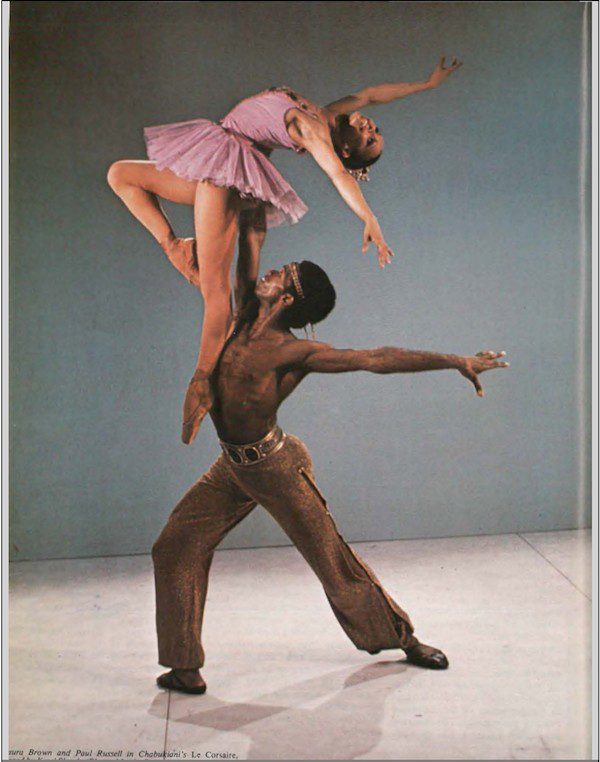
Today, I find myself reflecting nostalgically and appreciatively on the profound impact of Arthur Mitchell and the Dance Theatre of Harlem. In 2023, the Permanent Exhibition of “Harlem is…. Theater, Music, and Dance” at Harlem Hospital was installed, and I was fortunate to attend the installation ceremony. The honorees were undoubtedly deserving of their accolades; however, I couldn’t help but notice a glaring omission—Arthur Mitchell, the co-founder and director of the Dance Theatre of Harlem, was not recognized.
I reached out to Voza Rivers to understand why Arthur Mitchell was overlooked. Given his significant contributions to the inclusion of African-Americans in the world of ballet, I believe that the sponsors—Community Works, Harlem, Harlem Hospital, Harlem is…, and the New Heritage Theatre Group—owe the appreciative African-American community an explanation or, better yet, a plan to honor someone who has played such a crucial role in enriching our cultural landscape.
Arthur Mitchell’s legacy is monumental, and including him in this exhibition would not only celebrate his achievements but also inspire future generations to build on his pioneering work. — Ronald Bunn, ROUTES, Publisher, Editor
Dance Theatre of Harlem: A Testament to Excellence
In the somewhat bewildering, but highly imaginative language of New York City’s black teenagers, the highest compliment one can give something or someone is to call it, him, or her “the joint.” Conversely, the biggest put-down is to refer to the object of their scorn as “wack.” With these descriptions as a guide, one can only say that The Dance Theatre of Harlem (DTH), which is world famous for its artistry and skill in the field of ballet, has definitely proven itself to be “the joint.” And those ballet traditionalists and critics who fail to recognize this can properly be called “wack.”
Breaking Stereotypes and Achieving Mastery
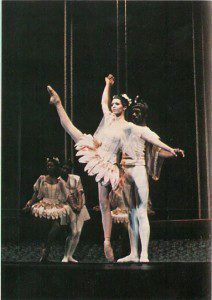
“Bugaku”.
The eight-year-old company, under the dedicated leadership of Arthur Mitchell and Co-Director Karel Shook, has earned accolades by providing ballet lovers throughout the world with many evenings of brilliant and scintillating dance. And while doing so, they have permanently laid to rest that old myth, which was often subtly perpetuated by many ballet conservatives, that black dancers with their ample round behinds and curvy bodies aren’t really physically suited to dance true classical ballet. By the conservatives’ own admission, the classicism of ballet is found in the perfection of the technique (way of performing). The complete domination and control of the body is absolutely essential to attain this perfection. Dance Theatre of Harlem has done just that both individually through its dancers and collectively as a company.
Expanding Ballet’s Appeal
No one who has ever seen DTH dancing everything from Balanchine’s austere “Concerto Barocco” or Louis Johnson’s soulful “Forces of Rhythm” to Geoffrey Holder’s colorful “Dougla” can continue to support such myths with a straight face. And to do so becomes almost as ridiculous as the exclusion of women from ballet before the 1680s. What DTH has done is to combine technical mastery, developed by many hours of continuous rehearsing, with that elusive element called soul. The result is a dance style that has done more to broaden ballet’s appeal to black people than all those school lectures on “culture” ever did.
The Beauty and Technique of DTH Dancers
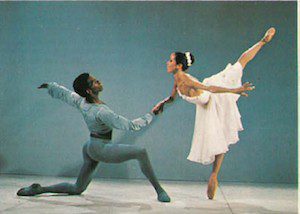
As the curtain goes up and the DTH dancers appear on stage, the first thing that impresses one is the sheer beauty of the company. In the 1950s, Ruth Brown used to sing a song about “fine brown frames.” She must have been singing about that decade’s version of the DTH dancers. Of course, being Black Americans, some are darker than brown while others are lighter, but that’s beside the point. DTH dancers definitely have fine frames. Once they start dancing, one instantly sees that their beauty is much more than skin deep. As they Grand Jeté (leap), Pirouette (twirl), Glissade (glide), and do all the intricate acrobatic and precise movements that make up classical ballet, it becomes obvious that these are superb technicians who have dedicated hours of practice and determination to their art.
A New Appreciation for Ballet
Long before the end of their performance, especially before a predominately black audience who has traditionally, at best, ignored or, at worst, ridiculed ballet and all it stands for, one could almost see and feel years of anti-ballet clichés fading from the audience’s mind. In their place comes a new appreciation of ballet as another valid dance expression to be used by Black people; not a superior expression, as it is often so arrogantly heralded by traditionalists, but another valid one. Of course, another reason for DTH’s appeal to its new audience is that a typical evening’s program includes not only the cool, highly stylized works of Balanchine and other members of the ballet establishment, but also the warm, more soulful and energetic ballets of Louis Johnson, Geoffrey Holder, and Arthur Mitchell himself.
The Source of Talent
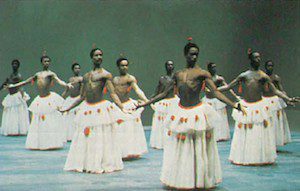
Indian Kathakali movements. (Photo: Martha Swope)
You may well ask, from where do these dancers come? Does Mitchell pluck them out of some equivalent of a dance haven in the sky? The answer is that they do come from a dance haven, but it’s not in the sky. Rather it’s located on 152 St. in Harlem and it’s the place where the company studies daily under dance masters, where they develop the technique and style that has bedazzled dance audiences in Europe, The Caribbean, and all over the United States.
Comprehensive Dance Education
It’s also the place where 1,100 students of all ages and nationalities are currently being taught and nurtured. They are taught every aspect of dance with the emphasis on tap, modern, classical, and ethnic. Though some classes are still open to everyone, most are now geared to those students who are seriously interested in dance careers. This group goes through a rigorous and thorough one and one-half hours of rehearsal each day. It is most assuredly not a program designed for dilettantes. It is a demanding and necessary schedule. But perfection does not come easy. The desire to dance and to dance with an ability up to the standards of DTH must be single-minded.
Accessibility for All
For those of all ages who love dance, but don’t have quite that commitment or who want to study dance for its exercise value, there are classes available at very reasonable fees. In fact, all of DTH’s fees are reasonable. For further information call (212) 690-2800.
The Founding Vision
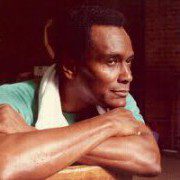
When he started DTH eight years ago at the Church of the Master in Harlem, Mitchell, then a superstar dancer with the New York City Ballet Company was quoted to have said that “After Martin Luther King was assassinated and there were all the eulogies, I asked myself what can you do? When you pay homage, you do the thing you do best. If you make music, you beat your drum; if you are a singer, you sing your song; if you are a dancer, you dance.” And you establish an institution like DTH. You teach your skills to young dance students. You develop an excellent company like DTH.
Invitation to Support
ROUTES is pleased to take part in the celebration of what has become one of America’s wonders. In an effort to win continued support on behalf of their excellence and will to exist, we invite you, our readers, to become patrons and supporters of DTH in whatever way you can. Their efforts should not go unheralded and the best way to make sure they stay alive and kicking is through your dollars and patronage. Support Dance Theatre of Harlem.
UPDATES
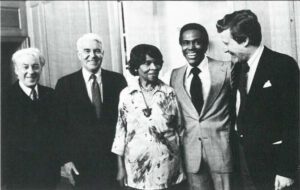
In celebration of Dance Theatre of Harlem’s Founders’ Week, honoring founders Arthur Mitchell and Karel Shook, join Robert Garland, DTH Resident Choreographer and School Director, for a panel discussion about the history of Black dance in Washington, D.C., the impact of DTH on the Washington, D.C. community and the legacy of the Kennedy Center/DTH Residency,
featuring:
Sandra Fortune-Green
Artistic Director, Jones-Haywood Dance School
Jeanette McCune
Director of School and Community Programs, Kennedy Center for the Performing Arts
Donna Walker-Kuhne
President, Walker International Communications Groups, Inc.
Ashanté Green
School Director, Dance Institute of Washington
Summerside Chats: Artist to Artistic Director — Jul 23, 2021
Mr. Mitchell’s influence spans several generations of artists as the Co-Founder and Artistic Director of Dance Theatre of Harlem. Driven by his mission, many DTH alumni were inspired to take their work beyond the stage becoming teachers, ballet masters, arts administrators, and directors. Panelists include DTH alumni from across the country who are now artistic directors of some of the most reputable ballet companies today.
Moderated by DTH Resident Choreographer Robert Garland (@robertgarland), panelists include DTH alumni:
Waverly Lucas & Nena Gilreath, Founders and Artistic Directors, Ballethnic Dance Co (@ballethnic)
Kevin Thomas, Artistic Director, Collage Dance Collective (@collagedance)
Tyrone Brooks, Artistic Director, Tallahassee Ballet (@thetallahasseeballet)
Jarina Carvalho, Founder & Artistic Director, Live Oak Dance (@liveoakdancenola)
Nikki Hefko, Owner & Artistic Director, New Orleans School of Ballet (@neworleansschoolofballet)
Luis Dominguez, Artistic Director of Lexington Ballet (@lexingtonballet)